
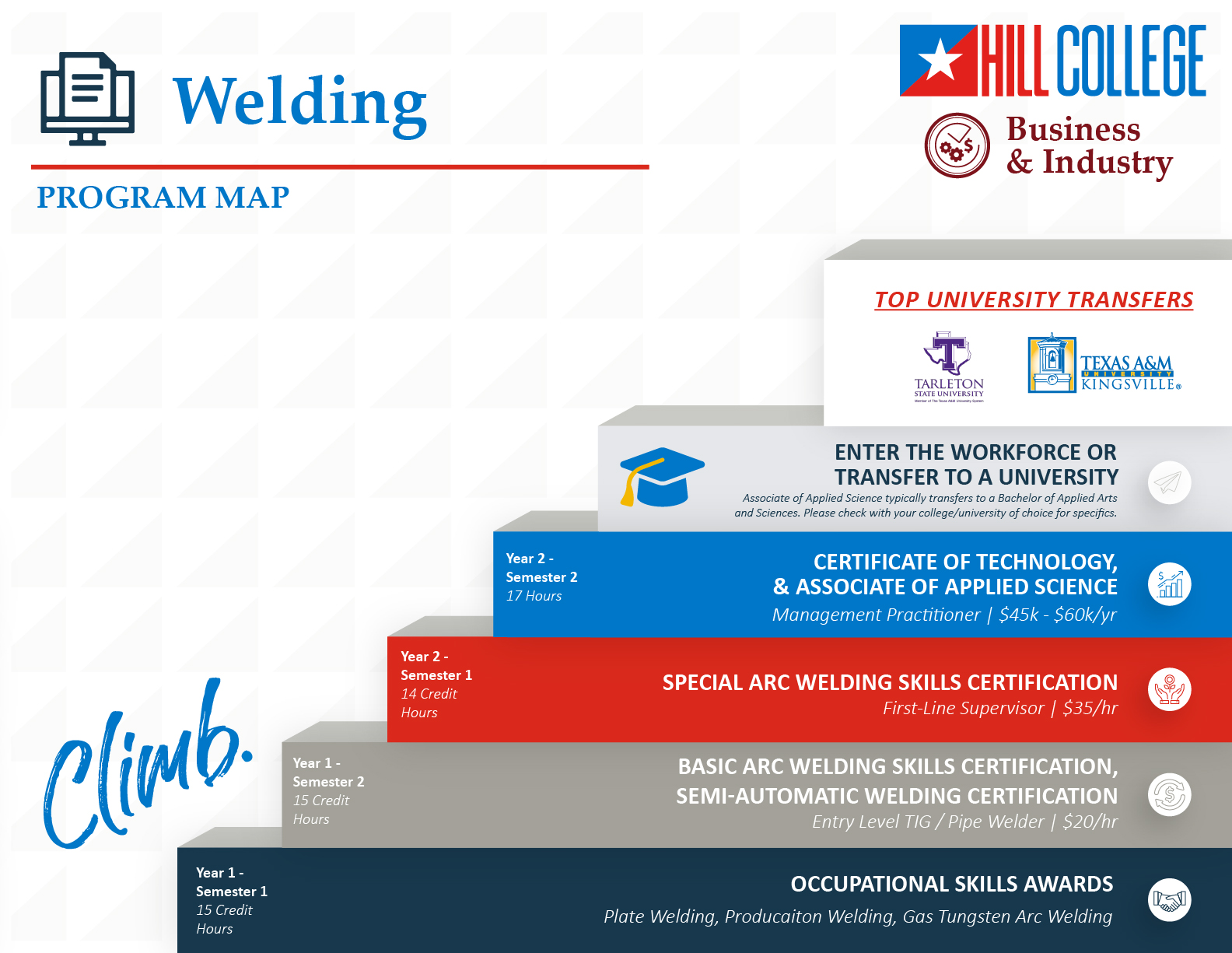
Welding Program Map
A program map is an easy-to-follow guide that shows all the courses and credit hours you’ll need to earn your degree or certificate. Click the tabs below the program name to see exactly what to take each semester and how quickly you can reach graduation. With a clear plan in front of you, staying on track and reaching your goals is simple!
Welding

12 Credit Hours
Plate Welding |
Production Welding |
| Intro to Blueprint Reading Intro to Shielded Metal Arc Welding Intermediate Shielded Metal Arc Welding |
Intro to Flux Core Arc Welding Intro to Blueprint Reading for Welders Intro to Gas Metal Arc Welding |
Gas Tungsten Arc Welding |
|
| Intro to Blueprint Reading for Welders Intro to Gas Tungsten Arc Welding Advanced Gas Tungsten Arc Welding |
16 Credit Hours
Basic Arc Welding Skills |
Semi-Automatic Welding |
|
Year 1: Semester 1 Year 1: Semester 2 |
Year 1: Semester 1 Year 1: Semester 2 |
Special Arc Welding Skills |
|
|
Year 1: Semester 1 |
Year 1: Semester 2 Intro to Gas Tungsten Arc Welding Intermediate Shielded Metal Arc Approved Welding Elective |
|
Year 2: Semester 2 |

49 Credit Hours
Year 1: Semester 1 |
Year 1: Semester 2 |
|
Intro to Blueprint Reading for Welders |
Gas Metal Arc Welding OR Approved Welding Elective Intro to Gas Tungsten Arc Welding Intermediate Shielded Metal Arc |
Year 2: Semester 1 |
Year 2: Semester 2 |
|
Welding Codes OR |
Business Computer Applications Welding Codes OR Welding Safety, Tools and Equipment Intermediate Pipe Welding Welding Using Multiple Processes |

61 Credit Hours
Year 1: Semester 1 |
Year 1: Semester 2 |
|
Business Computer Applications |
Composition I
|
Year 2: Semester 1 |
Year 2: Semester 2 |
|
Welding Codes OR |
Welding Codes OR Welding Safety, Tools and Equipment Intermediate Pipe Welding Welding Using Multiple Processes Social and Behavioral Science Core Language, Philosophy and Culture OR Creative Arts Core |
Top University Transfers


Contact

Joe Price
Program Coordinator
jprice@hillcollege.edu
254.659.7984
Program Outcomes
Graduates of the program will be able to:
Apply knowledge of industrial safety standards to both field and factory environments.
Demonstrate proficiency in multiple welding processes and principles of fabrication.
Apply knowledge of the characteristics of metallurgy to industrial joining techniques, material joining processes, and manufacturing standards.
Understand professional, ethical, and social responsibilities and their implications related to the practice of welding technology in a global/social context.
Use workplace skills to promote profit, product, and service quality as related to the welding industry.
Johnson County Campus Tool List